
Enable self-service reporting, natural language queries, and faster insights across your Oracle EBS environment.
by Amit Agrawal, Associate Director, Oracle ERP Services, Data Intensity
If you support Oracle E-Business Suite, you’re probably familiar with a common challenge: the data is there, but getting to it quickly isn’t always easy.
Business users need answers. Finance wants payment details. Supply chain teams want inventory visibility. Operations leaders need to understand order delays. Yet too often, obtaining that information means navigating multiple EBS screens, submitting report requests, waiting for IT support, or writing custom SQL queries.
At a time when IT teams are being asked to do more with less, those reporting bottlenecks can become a significant drain on productivity. Valuable technical resources spend time responding to routine information requests, while business users wait for answers that already exist somewhere within the system.
Ask EBS was designed to change that.
Why Oracle EBS Reporting Creates Bottlenecks
Oracle E-Business Suite remains one of the most powerful enterprise applications available today. The challenge isn’t a lack of data. It’s accessibility.
Many organizations still rely on a familiar process:
- A business user has a question
- A report request is submitted
- Someone with EBS expertise builds or modifies a query
- Results are delivered hours or days later
For simple questions, the process often feels disproportionate to the business need.
The challenge isn’t that EBS lacks information. The challenge is helping users find the answers they need without relying on technical resources or navigating complex application workflows. That’s where Ask EBS comes in.
Introducing Ask EBS
Ask EBS brings conversational AI and natural language querying capabilities to Oracle E-Business Suite. Instead of navigating through menus, running reports, or writing SQL, users simply ask questions in plain English. Ask EBS interprets the request, retrieves the relevant data, and returns results in an easy-to-understand format.
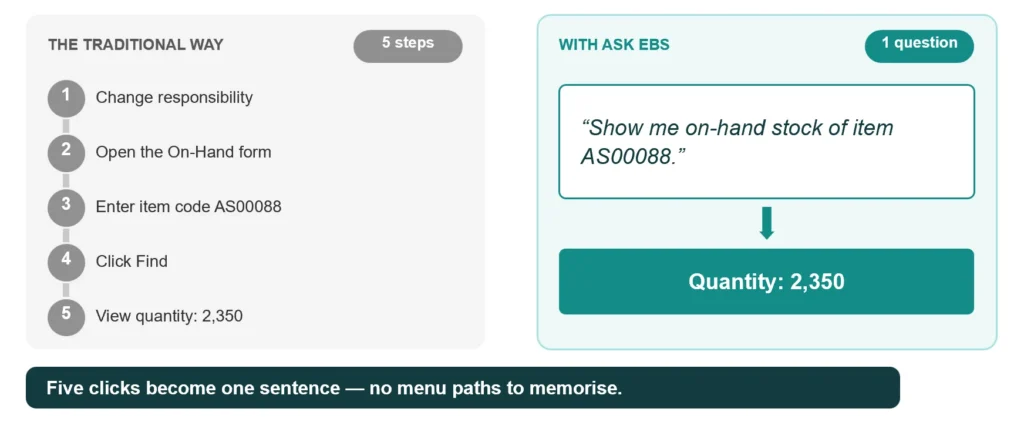
The underlying data hasn’t changed. The user experience has.
By removing complexity from the process, Ask EBS helps organizations unlock more value from the EBS investment they’ve already made.
How Ask EBS Works
At a high level, the process is straightforward:
- A user asks a question in plain language
- The solution interprets the business request
- The request is translated into the appropriate database query
- Data is retrieved from Oracle EBS
- Results are returned in a user-friendly format
Because Ask EBS operates within existing Oracle EBS security frameworks, users only see the data they are authorized to access. Organizations maintain established security controls while providing a significantly simpler way to interact with enterprise data.
Users can also explore results further, making Ask EBS more than a simple question-and-answer tool. It becomes a conversational analytics layer that helps users understand, investigate, and act on business information.
Real-World Oracle EBS Use Cases
The value of conversational AI becomes especially clear when applied to everyday business questions. The common thread is simple: users ask questions the way they naturally think about their business.
| Inventory Management Inventory teams can ask questions such as: * Show item reservations for all items with reservations * Show available stock across organizations for a specific item * How many cycle count headers exist by organization | Order Management Customer service and operations teams can quickly identify: * Delayed orders * Scheduled versus actual ship dates * Sales representatives associated with specific orders |
| Manufacturing Operations Manufacturing leaders can investigate: * Open work orders * Work orders containing scrapped materials * Rejected quantities across production orders * Quality-related procurement issues | Finance and Accounts Payable Finance users can request: * Invoice-to-payment reconciliation information * Supplier payment summaries * Top suppliers by payment value * Historical payment analysis |
How Ask EBS Differs from Traditional BI Tools
Organizations often ask how Ask EBS fits alongside existing reporting and business intelligence solutions. The answer is that Ask EBS complements them.
Traditional BI platforms excel at dashboards, scorecards, visualizations, and scheduled reporting. They are incredibly effective when users know exactly what information they want to monitor.
Ask EBS addresses a different challenge: it empowers users to ask ad hoc business questions in natural language and receive immediate answers without waiting for a report to be built or a dashboard to be modified.
Instead of replacing business intelligence tools, Ask EBS extends the value of enterprise data by making it more accessible to a broader audience.
Business Benefits of Ask EBS for Oracle E-Business Suite
For Oracle EBS administrators and support teams, Ask EBS helps reduce the constant demand for custom reports and one-off data requests. The benefits?
- Faster access to business information
- Reduced dependency on technical resources
- Self-service reporting capabilities
- Improved productivity across departments
- Accelerated decision-making
- Better utilization of Oracle EBS data
- Reduced reporting bottlenecks
- Improved business agility
For business users, the benefit is equally compelling. Instead of waiting for answers, they gain the ability to explore information independently and make decisions with greater confidence.
For IT teams, it creates breathing room to focus on strategic projects rather than routine reporting requests.
The goal isn’t to replace EBS expertise: it’s to extend it. It enables users to answer routine questions on their own while allowing Oracle EBS experts to focus on more strategic work.
Who Benefits from Ask EBS
- Oracle EBS administrators
- IT application support teams
- Finance and accounting departments
- Supply chain organizations
- Procurement teams
- Manufacturing operations
- Customer service groups
- Business analysts
- Executive leadership teams
Any organization looking to improve Oracle EBS reporting, self-service analytics, or business data accessibility can benefit from a conversational approach.
Making Your EBS Investment More Valuable
Most Oracle E-Business Suite environments contain years of operational, financial, and transactional data. The challenge is rarely collecting information. The challenge is making that information accessible.
Ask EBS helps bridge the gap between business users and enterprise data.
By combining Oracle EBS, generative AI, conversational analytics, and natural language queries, organizations can deliver information faster, reduce reporting friction, and empower users to find answers on their own.
The future of enterprise applications isn’t simply generating more data. It’s making data easier to access, understand, and put into action.
Ready to See Ask EBS in Action?
The best way to understand the impact of conversational AI inside Oracle E-Business Suite is to experience it firsthand.
Whether you’re looking to reduce reporting bottlenecks, empower business users with self-service access to information, or help your IT team focus on higher-value initiatives, Ask EBS can help unlock more value from the Oracle EBS environment you already have.
Schedule a personalized Ask EBS demonstration with our EBS experts and see how conversational AI can transform the way your organization accesses and uses enterprise data. Contact Data Intensity or submit the form below to discover what Ask EBS can do for your business.
Frequently Asked Questions About Ask EBS
Ask EBS is a conversational AI solution that enables users to interact with Oracle E-Business Suite using natural language instead of traditional reports, menus, or SQL queries.
Users submit a question in plain English. The system interprets the request, generates the appropriate query, retrieves data from Oracle EBS, and presents the results in an easy-to-consume format.
No. Ask EBS complements existing reporting and analytics tools. It is particularly effective for ad hoc questions and self-service data exploration that may not be covered by existing reports or dashboards.
Yes. One of the primary benefits of Ask EBS is that users can interact with Oracle EBS data using business language rather than requiring SQL or technical reporting expertise.
Yes. Ask EBS respects existing Oracle EBS security roles and access controls, ensuring users only see data they are authorized to view.
Organizations can leverage Ask EBS across finance, supply chain, inventory, manufacturing, procurement, order management, and other areas where users need faster access to operational data and insights.