A Comprehensive Guide to the Industry’s Leading Multicloud Database Platform
Originally published March 2024 · Updated April 2026
We receive a lot of interest from our customers about their options for migrating Oracle workloads to the cloud. Since we first published this blog in early 2024, Oracle Database@Azure has evolved from a single-region, single-service offering into the industry’s broadest multicloud database platform — now spanning 30+ Azure regions, five database services, and a rapidly growing list of enterprise customers including Air France-KLM, Vodafone, Activision Blizzard, Conduent, and Wolters Kluwer. In fact, Oracle’s CEO highlighted that the multicloud database business grew 817% year-over-year as of Q2 FY26.
This updated post reflects everything that has changed and provides a current picture of Database@Azure, the broader Oracle–Microsoft partnership, and how Data Intensity can help you take advantage of it.
Background: The Oracle-Microsoft Partnership
Microsoft and Oracle have had a partnership in place since 2019, which resulted in a network interconnect between Oracle Cloud Infrastructure (OCI) and Azure in select data centers worldwide. In 2021, the interconnect was enhanced to include an Azure-like portal for provisioning OCI database PaaS services, known as Oracle Database Service for Azure (ODSA).
The interconnect delivers direct, fast, and highly reliable network connectivity between the two clouds. You can run application servers in Azure while your database runs on OCI, with single-digit-millisecond latency. This remains an excellent option for pulling data from transaction stores into Oracle Autonomous Data Warehouse or Azure Data Lake, and for connecting Power BI to Autonomous Data Warehouse for reporting. Importantly, there are no egress charges on either cloud for interconnect traffic.
In late 2023, the partnership took a major leap forward with the launch of Oracle Database@Azure—co-locating Oracle Exadata hardware directly inside Azure data centers, fully managed by Oracle, provisioned and managed through the Azure portal.
ODSA vs. Oracle Database@Azure
ODSA depends on the Oracle–Azure interconnect and is available only in regions where that interconnect exists. It provides an Azure-like portal for OCI database services, including ExaCS, Base Database, MySQL HeatWave, and Autonomous Database Serverless. The biggest advantage remains zero egress charges on either cloud.
Oracle Database@Azure is NOT dependent on the interconnect. Oracle Exadata hardware is physically installed inside the Azure data center, managed by Oracle. This eliminates cross-cloud latency entirely—delivering microsecond latency between your Azure application tier and Oracle database tier. You use the Azure portal and Azure APIs to provision and manage all Oracle database services. You purchase through the Azure Marketplace, and consumption can count toward your Microsoft Azure Consumption Commitment (MACC).
If you have many databases to migrate, Database@Azure gives you the best combination of Exadata-grade performance, consolidated licensing, and deep Azure-native management. ODSA remains a viable option when the interconnect model fits your architecture or when you need services not yet available in Database@Azure.
Five Database Services + Two Database-Related Services
Database@Azure offers a comprehensive portfolio of five core database services to match every workload size and budget, plus two database-related services that support migration, replication, and data protection. For the most current regional availability of each service, visit the Oracle Multicloud Capabilities page.
Core Database Services
- Oracle Exadata Database Service on Dedicated Infrastructure
The flagship service for large enterprises with the most demanding workloads. You get dedicated Exadata hardware with full Oracle RAC for high availability, Data Guard for disaster recovery, and all Exadata performance features—automatic indexes, hybrid columnar compression, flash cache, smart scan, and storage indexes. Ideal for organizations with strict compliance, predictable performance needs, or large database consolidation projects. Though an Exadata system may have 252 cores available, you only pay for the cores you enable, and more than half of DSS workload processing occurs in the storage layer’s 144 cores—reducing your CPU and license requirements in the database layer. - Oracle Autonomous AI Database on Dedicated Exadata Infrastructure
Combines the power of dedicated Exadata hardware with Oracle’s fully autonomous database management. Provisioning, tuning, patching, backups, and scaling are fully automated. You get the isolation and predictability of dedicated infrastructure with the operational simplicity of an autonomous database. This is well-suited for regulated industries that need dedicated resources but want to eliminate DBA overhead for routine operations. - Oracle Autonomous AI Database Serverless
A fully managed, serverless database that elastically scales compute and storage based on workload demand—you pay only for what you use. It is ideal for variable workloads, cloud-native applications, and organizations that want zero infrastructure management. Built-in AI Vector Search, native integration with Azure Entra ID, Azure DevOps, Visual Studio Code, Azure API Management Service, and Microsoft Teams make it a natural fit for Azure-centric development teams. Autonomous Database also powers the Oracle Autonomous AI Lakehouse, which is built on Apache Iceberg and integrates natively with Microsoft Fabric and Power BI for unified AI and analytics. - Oracle Exadata Database Service on Exascale Infrastructure
Delivers Exadata-grade performance on shared infrastructure with up to 95% lower minimum infrastructure costs compared to Dedicated Infrastructure. Exascale’s intelligent data architecture lets you start small and elastically scale compute and storage independently. This is the right choice for mission-critical workloads at any scale—from small departments and ISVs needing Exadata performance in multiple regions, to large enterprises that want to right-size infrastructure by business unit or budget. - Oracle Base Database Service
The simplest and most affordable entry point for running Oracle Database natively in Azure. It provides a single-instance Oracle Database on managed VM-based infrastructure with flexible ECPU-based billing and independently scalable block storage. Supports Oracle Database Enterprise Edition and Standard Edition 2, with a choice of 19c, 23ai, or 26ai. Ideal for dev/test environments, non-mission-critical workloads, or organizations just beginning their Oracle cloud journey who want a low-risk starting point before scaling to Exadata.
Database-Related Services
- Oracle Database Autonomous Recovery Service
Provides automated, policy-driven backup and recovery with zero data loss protection for Oracle databases on Database@Azure. It eliminates manual backup management and provides point-in-time recovery capabilities that meet the most stringent RPO and RTO requirements. Available in the majority of Database@Azure regions. - OCI GoldenGate
A real-time data integration and replication service that ensures high availability, disaster recovery, and transactional integrity across diverse environments. GoldenGate enables real-time change data capture, data transformations, and bidirectional replication between Oracle databases on-premises, on OCI, and on Database@Azure—as well as to non-Oracle targets including Microsoft Fabric, Azure Data Lake Storage, Databricks, and Snowflake. It can be purchased using MACC. We cover the powerful GoldenGate–Fabric integration in detail below.
Global Regional Footprint: 33 Azure Regions
Database@Azure is live in 33 Azure regions across North America, EMEA, Asia Pacific, and Latin America. All five core database services and both database-related services (Autonomous Recovery Service and GoldenGate) are available in every region. The full-feature services (Exascale, Base DB, Autonomous on Dedicated) vary by region. For the definitive and most current view, see the Oracle Multicloud Capabilities page or Microsoft’s region availability documentation.
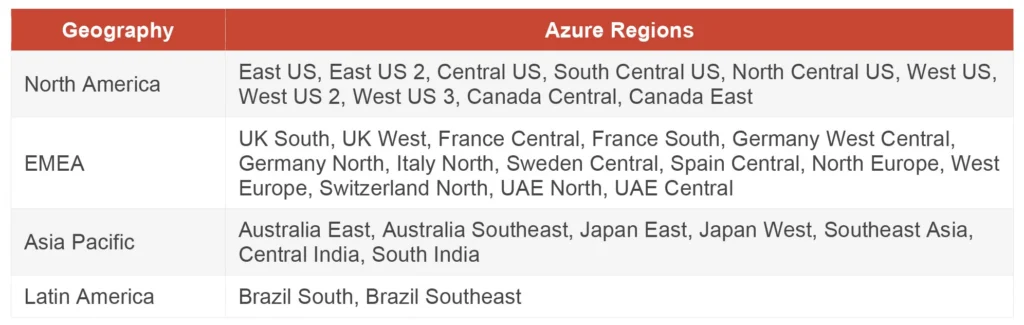
Many of these regions support dual-zone high availability for Oracle MAA configurations, and single-zone regions are paired with disaster recovery regions for cross-region protection. Oracle and Microsoft continue to add new regions based on customer demand.
Microsoft Fabric, OCI GoldenGate, and Database@Azure: The Real-Time Data and AI Pipeline
One of the most compelling capabilities of the Oracle–Microsoft partnership is the integration of OCI GoldenGate, Microsoft Fabric, and Database@Azure into a unified real-time data and AI pipeline. This combination eliminates the traditional complexity of building ETL pipelines between Oracle transaction systems and Microsoft analytics platforms.
How It Works
OCI GoldenGate captures changes from Oracle databases running on Database@Azure (Exadata, Autonomous, Exascale, or Base DB) in real time using change data capture (CDC). These changes are streamed continuously into Microsoft Fabric OneLake through GoldenGate’s native integration with Fabric’s Open Mirroring feature. Open Mirroring keeps data continuously synchronized in Delta Lake / Apache Iceberg format, ensuring it is always analytics-ready within Fabric—without requiring batch ETL jobs, custom code, or data movement orchestration.
Once data lands in OneLake, the full Microsoft Fabric ecosystem becomes available:
- Power BI: Build dashboards and reports that reflect near real-time Oracle transactional data.
- Azure Synapse / Data Warehouse: Run complex analytical queries across unified Oracle and non-Oracle datasets.
- Microsoft Copilot Studio & Azure AI Foundry: Access Oracle data directly for no-code/low-code AI application development and intelligent workflows.
- Fabric Data Agents: Enable natural-language queries against Oracle databases—users can ask business questions in plain English and get answers powered by the mirrored Oracle data without writing SQL.
- Microsoft Purview: Apply unified data governance, cataloging, and compliance policies across Oracle and non-Oracle data assets.
Why This Matters
Traditionally, getting Oracle transactional data into an analytics platform required batch ETL processes with significant latency, custom integration code, and ongoing maintenance. The GoldenGate–Fabric–Database@Azure integration replaces all of that with a managed, real-time pipeline that:
- Reduces engineering effort and time-to-insight dramatically
- Keeps analytics and AI models working with the freshest data
- Supports both Oracle and non-Oracle data sources through GoldenGate’s heterogeneous connectors
- Works with all Database@Azure services—Exadata, Autonomous, Exascale, and Base DB
- Eliminates the need for separate data replication infrastructure; GoldenGate is available as a managed service directly on Database@Azure and is MACC-eligible
For a detailed walkthrough, see Microsoft’s technical blog: Accelerate AI on Oracle Databases with Open Mirroring, Fabric Data Agent, and Azure AI Foundry.
Deep Azure Integration
Database@Azure is not just Oracle hardware in an Azure data center—it is deeply woven into the Azure management, security, and governance fabric. The following integrations have been validated and are generally available or in public preview (see Microsoft’s Oracle on Azure blog and Azure’s What’s New with Database@Azure for details):
Identity & Access
Microsoft Entra ID (Azure AD): Unified identity and access management for Oracle databases. Single sign-on, conditional access, and MFA policies apply to Database@Azure resources.
Security & Compliance
- Microsoft Defender for Cloud: Cloud-native threat protection, vulnerability management, and automated compliance for Oracle Database@Azure workloads.
- Azure Key Vault: Store Oracle Transparent Data Encryption (TDE) keys in Azure Key Vault Standard, Premium, or Managed HSM—giving customers full control of their encryption strategy within Azure.
- Microsoft Purview: Data governance, cataloging, and compliance for Oracle Exadata and Autonomous Database services on Database@Azure.
Management & Operations
- Azure Arc: Unified management, governance, and policy enforcement across hybrid and multicloud Oracle environments from a single control plane.
- Azure Monitor: Stream Exadata infrastructure logs and events directly into Log Analytics, Event Hub, and Azure Monitor alerts for native operational visibility.
- Azure Backup: Integration for additional backup capabilities alongside Oracle’s Autonomous Recovery Service.
- Terraform & Azure Resource Manager: Infrastructure-as-code provisioning and lifecycle management for automated, repeatable deployments.
- Azure Tags in OCI: Apply Azure tagging conventions to Oracle resources for consistent cost management and governance.
Networking
- Network Security Groups (NSG): Fine-grained inbound security policies for controlling access to Oracle databases.
- Azure Private Link: Private, secure connections between Azure services and Database@Azure, reducing public internet exposure.
- Global VNet Peering: Cross-region interconnectivity over Azure’s physical network backbone for disaster recovery and geo-redundancy.
- ExpressRoute FastPath: Ultra-low-latency connections between Azure VMware Solution (AVS) or on-premises environments and Database@Azure.
- User Defined Routes (UDR): Route traffic through Azure Firewall or third-party NVAs for enterprise traffic inspection.
Data & Analytics
- Microsoft Fabric & OneLake: Real-time data synchronization via GoldenGate Open Mirroring and Oracle Database Mirroring in OneLake (public preview) for zero-ETL analytics.
- Power BI: Native connectivity to Oracle Autonomous AI Lakehouse and Database@Azure for operational and analytical reporting.
- Microsoft Copilot Studio & Azure AI Foundry: Direct Oracle data access for no-code/low-code AI applications and intelligent agent workflows.
Oracle Applications Support on Azure
Oracle has published official support policies for running major Oracle application suites in Microsoft Azure using Database@Azure. This means you can deploy your entire Oracle stack—application and database tiers—within Azure with full Oracle support. The announcement details are available in the Microsoft TechCommunity blog post. The individual My Oracle Support policy documents (requiring MOS login) are:
| APPLICATION | MOS DOC ID | REFERENCE ARCHITECTURE |
| Oracle E-Business Suite | 3015095.1 | Oracle EBS on Database@Azure |
| Oracle PeopleSoft | 3066767.1 | PeopleSoft on Database@Azure |
| Oracle JD Edwards EnterpriseOne | 3067119.1 | JDE on Database@Azure |
Oracle also supports Oracle Maximum Availability Architecture (MAA) up to Platinum tier—available exclusively on Azure among hyperscalers—providing the highest levels of availability, disaster recovery, and zero-data-loss protection for mission-critical application workloads. The reference architecture links above are from Oracle’s multicloud documentation.
AI-Ready: Oracle Autonomous AI Lakehouse
Oracle Autonomous AI Lakehouse, now generally available on Database@Azure, is built on the open-source Apache Iceberg format and powered by Oracle AI Database 26ai. It unifies AI, analytics, and open data into a single platform that integrates seamlessly with Microsoft Fabric, Power BI, and Azure AI Foundry. Azure users can apply advanced AI models to their Oracle and non-Oracle data regardless of where it resides.
Customers can choose Oracle Database 19c for long-term enterprise stability, 26ai for next-generation AI workloads with native AI Vector Search. Database version flexibility applies across all five database services.
Saving Money with Database@Azure
Database@Azure provides multiple pathways to optimize cloud spending:
- Right-size with Exascale: Get Exadata-grade performance with up to 95% lower minimum infrastructure cost. Start small and scale independently.
- Start simple with Base DB: Flexible ECPU-based billing for dev/test and non-mission-critical workloads without overprovisioning.
- Consolidate on Exadata: Reduce total core count through Exadata storage offloading, where 144 storage-server cores handle DSS workloads and reduce CPU/license requirements in the database layer.
- Pay only for cores you enable: On Exadata Dedicated, though 252 cores are available, you pay only for enabled cores.
- No infrastructure DBAs needed: Oracle manages all infrastructure maintenance, OS patching, and security.
- Flexible purchasing: Pay-as-you-go from Azure Marketplace, MACC-eligible, BYOL, ULA, and Oracle Multicloud Universal Credits.
- Zero-cost developer licenses: Oracle offers zero-cost database licenses for developers on Exadata and Base Database Service, eliminating trade-offs between dev and production environments.
- Performance without code changes: Automatic indexes, hybrid columnar compression, flash cache, smart scan, and storage indexes improve application performance without a single line of code change.
The Broader Multicloud Picture
Database@Azure is part of Oracle’s broader multicloud strategy. Oracle now offers similar co-located database services on AWS (Oracle Database@AWS) and Google Cloud (Oracle Database@Google Cloud). The Oracle Multicloud Universal Credits program allows customers to procure Oracle AI Database and OCI credits usable across all three hyperscalers and OCI—providing maximum flexibility for multi-cloud enterprises. Oracle’s CEO noted that the multicloud database business grew 817% year-over-year as of Q2 FY26, underscoring the momentum behind this model.
Data Intensity: Your Trusted Guide to Database@Azure
At Data Intensity, we possess deep expertise in every component of the Database@Azure stack: Oracle Database, Oracle Exadata, OCI, Azure, and multicloud architecture. As a trusted Oracle Strategic Cloud MSP partner, we have exclusive access to OCI technical and product teams to review architectures and deliver the most cost-efficient solutions for our clients.
Our team leverages a proprietary ‘Total Cost of Transformation’ framework to assess your Oracle workloads for Database@Azure, design the network architecture, and recommend the optimal Oracle license options. Whether you’re exploring the new Exascale and Base Database entry points, planning an EBS-on-Azure migration, building a real-time analytics pipeline with GoldenGate and Microsoft Fabric, or modernizing with Autonomous AI Lakehouse—we can help.
If you would like to learn more about Database@Azure or running Oracle workloads in Azure, please feel free to contact us directly.